How the U.S. AI Data Center Boom Is Creating New Opportunities for AEC Firms in 2026

The U.S. AI data center boom is driving massive construction growth and creating new opportunities for AEC firms. Rising demand for BIM, CAD drafting, MEP coordination, structural detailing, shop drawings, and construction documentation is pushing firms to seek skilled outsourcing partners.

How the U.S. AI Data Center Boom Is Creating New Opportunities for AEC Firms in 2026

If you work in architecture, engineering, MEP, or CAD/BIM drafting anywhere in the United States, there's a good chance a data center project has already crossed your desk in 2026 - or is about to. What used to be a niche specialty inside commercial construction has become, in the space of about three years, one of the single biggest sources of new work in the entire AEC industry.

This piece breaks down what's actually driving the AI data center boom, where the money and the projects are going, which AEC disciplines are seeing the sharpest demand spikes, and - practically - how architecture, engineering, and drafting firms (including those relying on outsourced CAD and BIM production) can position themselves to capture a piece of it.

01

The Scale of the Boom, in Real Numbers

The headline number for 2026 is hard to overstate. J.P. Morgan estimates hyperscaler capital expenditure will reach $697 billion in 2026, and separate reporting puts the combined AI infrastructure commitment from Microsoft, Amazon, Alphabet, Meta, and Oracle at over $650–700 billion for the year - nearly double what those same companies spent in 2025. BloombergNEF pegs capital spending among the 14 largest publicly traded data center operators at close to $750 billion in 2026, up from under $450 billion the year before.

On the construction side, ConstructConnect data reported by CoStar shows U.S. data center construction starts hit $81.5 billion in just the first six months of 2026 - already ahead of the full-year 2025 total of $72.5 billion, and more than triple the 2024 figure. January 2026 alone saw a record $25.5 billion in new construction starts. Average monthly spending on data center starts has climbed from roughly $500 million in mid-2021 to more than $6.5 billion by the end of 2025.

MetricFigureDetail
2026 hyperscaler AI capex (JPMorgan est.)$697BMicrosoft, Amazon, Google, Meta, Oracle combined
2026 YTD construction starts (through June)$81.5BAlready exceeds all of 2025
2025 construction starts growth+190% YoY$77.7B total for 2025
Average data center footprint, Q2 2026~700,000 sq ftRoughly double the average size since 2022
Active + announced/under-construction U.S. data centers4,149 active / 2,788 moreAmerican Edge Project, Dec. 2025
Projected temporary construction jobs4.7 millionFrom the current build-out pipeline

Sources: J.P. Morgan, ConstructConnect/CoStar, American Edge Project, Wolf Street. Full citations below.

Beyond 2026, the trajectory only steepens. BloombergNEF projects data center power demand could roughly double global capacity from about 103 gigawatts today to 200 gigawatts by 2030, requiring as much as $3 trillion in new infrastructure investment - with some estimates from McKinsey and Nvidia executives running as high as $4–7 trillion by the end of the decade. That pipeline sits alongside other U.S. megaprojects already underway in 2026, from semiconductor fabs to grid and rail work.

“The AEC industry is very close to being overwhelmed by data center demand, especially for electricians. Every market is at full capacity and equipment vendors are super-stretched.”

- Tony TeVault, VP, Holder Construction (Atlanta)

02

Why This Is Different From Past Construction Booms

Unlike a typical commercial real estate cycle, this build-out isn't speculative - it's backed by the balance sheets of the largest, most cash-rich companies on earth, and it's compounding rather than cyclical. Alphabet raised its 2026 capex guidance to $195–205 billion, up from $91 billion in 2025. Meta's guidance moved to $130–145 billion. Microsoft's climbed to $175–190 billion. That capital has to physically land somewhere, and “somewhere” means architects, structural and MEP engineers, BIM coordinators, and drafting teams turning owner requirements into buildable documents on compressed timelines.

It's also a fundamentally more complex building type than the data centers of a decade ago. Rack densities that used to sit around 5–8 kilowatts are now routinely designed for 15–50 kW, with some AI-optimized campuses pushing toward 100 kW per rack. That shift is forcing a redesign of power distribution, structural loading, and - most dramatically - cooling, as direct-to-chip and immersion liquid cooling replace traditional CRAC units. Every one of those changes touches drafting, modeling, and coordination work.

03

The AEC Disciplines Seeing the Sharpest Demand

Recruiting and industry data consistently point to the same pressure points. According to ACEC's sentiment survey, 75% of engineering firms plan to increase hiring, with data centers posting the strongest sector sentiment score (+60) of any market they track - ahead of energy/utilities and industrial/manufacturing.

MEP Engineering & Coordination

General contractors on data center projects now expect MEP teams to prove real fabrication capability and deliver BIM-to-fabrication data that stays consistent from design through field install. Liquid cooling design, high-voltage distribution, and redundant power paths are the new baseline.

BIM Modeling & Clash Detection

Data center floors pack thousands of cable runs into tight structural grids, leaving little tolerance for error. Firms now lean on Revit, Navisworks, and clash-coordination workflows as the default single source of truth across architect, structural, MEP, civil, and commissioning teams.

Structural & Steel Detailing

Multi-story, heavy-load data center shells require precise structural steel detailing and shop drawings, particularly as campuses scale toward 100+ megawatt power envelopes and taller, denser builds replace single-story warehouses.

Permitting, As-Builts & Construction Documentation

With design-to-groundbreaking windows as short as 8–12 weeks and construction schedules of 7–9 months, teams need fast-turnaround permit sets, construction drawings, and as-built documentation to keep pace without becoming the bottleneck.

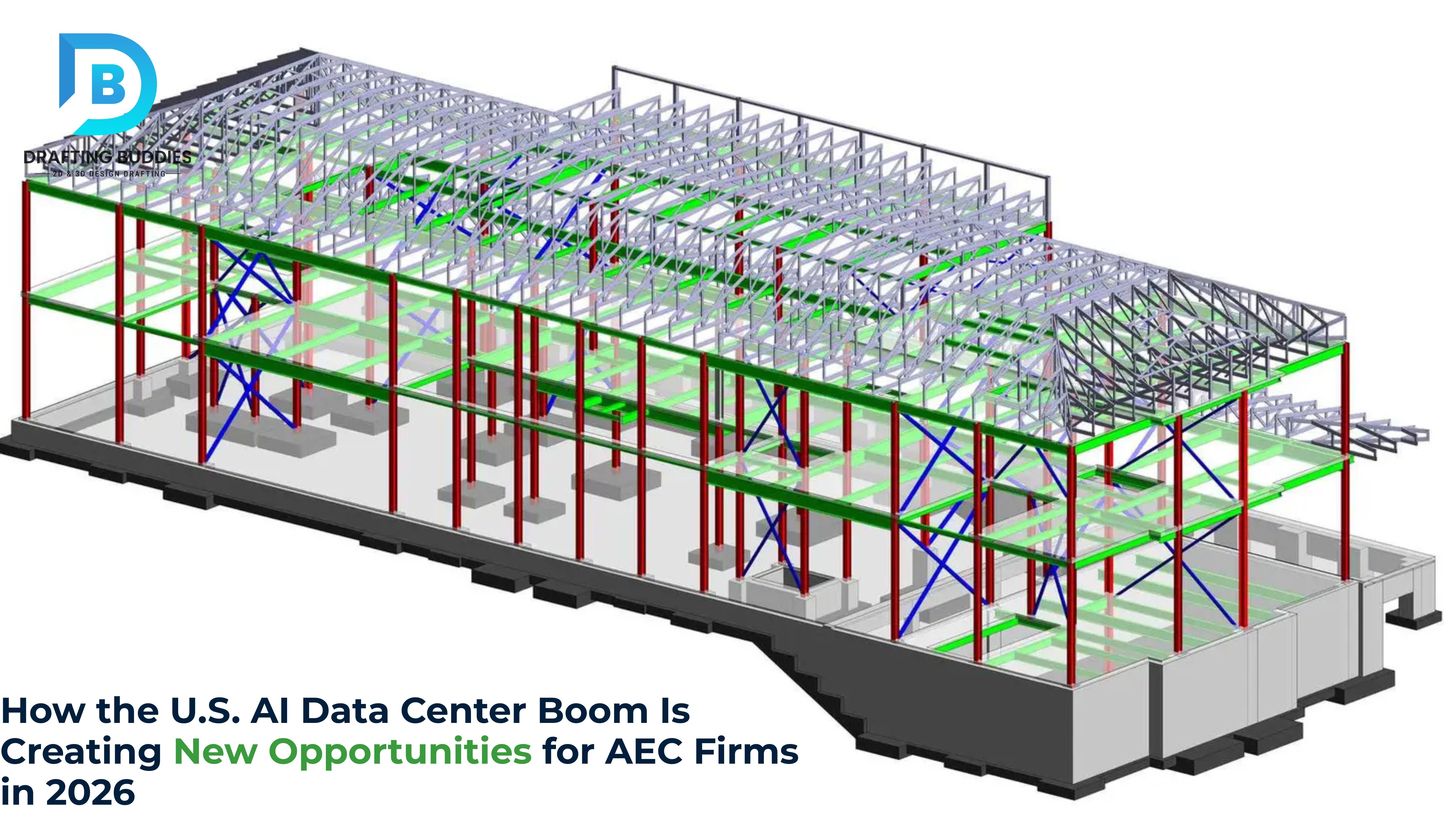
That demand shows up directly in MEP BIM, BIM modeling, structural steel detailing, and shop drawing production - the workstreams that turn a hyperscale program into coordinated, buildable documents.

Compensation is already signaling how thin the talent pool is

On the compensation side, staffing data from irecruit.co shows the pressure clearly - a strong signal of how thin the specialized talent pool has become.

RoleReported range
MEP coordinators and engineers$95,000–$165,000
Commissioning specialists$85,000–$125,000
Electrical infrastructure specialistsUp to $281,000 in the tightest markets
04

Where the Projects Are Actually Going

Northern Virginia remains the largest data center market in the country, but the boom has pushed well past the traditional hubs. Driven by land availability, cheaper power, and faster permitting, new campuses are landing across Texas, Ohio, Georgia, Indiana, Arizona, Illinois, New York, and increasingly the South and Midwest more broadly. Virginia led all states in 2025 data center start funding at $15.3 billion, with Louisiana close behind at roughly $15 billion. Dallas–Fort Worth has grown into the third-largest colocation market, with over 700 megawatts under construction.

That geographic spread matters for AEC firms specifically: staffing firm Actalent notes that as data centers expand into markets like Arizona, Georgia, Indiana, and New York, AEC firms are increasingly building in areas where they lack existing partnerships or local talent pipelines - which is exactly the gap that regional and outsourced design/drafting partners are positioned to fill. Firms already supporting Virginia BIM work, Texas BIM services, Georgia CAD drafting, and Arizona BIM production are closer to that pipeline than firms waiting to hire locally.

05

The Talent Bottleneck - And Why It's an Opening, Not Just a Problem

Every major report on this build-out repeats the same warning: capital is not the constraint, capacity is. JPMorgan reports wait times for generation step-up transformers have tripled. Deloitte's 2026 Engineering & Construction Industry Outlook flags data center outlays as the main reason overall structures investment is growing at all this year. And BloombergNEF estimates 30–50% of planned 2026 AI data center capacity could slip into 2028 because of grid interconnection queues and construction bottlenecks - not lack of demand.

For architecture, engineering, and drafting firms, that bottleneck cuts both ways. It means:

  • In-house teams are stretched thin. Firms that already have data center clients are struggling to staff up fast enough to hit compressed 7–9 month construction schedules.
  • Subcontracted and outsourced CAD/BIM production has become a release valve. Rather than hiring and training an entire in-house BIM or drafting bench for a building type most firms have limited experience with, many architecture and engineering firms are turning to specialized outsourcing partners for overflow drafting, MEP coordination modeling, structural steel detailing, and shop drawing production.
  • Smaller and mid-size firms can compete. As the Associated General Contractors' 2026 outlook notes, this isn't only a game for the giants - 65% of contractors surveyed expect available project dollar value to increase in 2026, and smaller firms are increasingly picking up scope as larger players hit capacity limits.

Scaling for data center work without the hiring risk

Drafting Buddies works as an extension of architecture, engineering, and MEP teams - delivering CAD drafting, BIM coordination, structural steel detailing, and shop drawings on the compressed timelines data center projects demand, without the overhead of standing up an in-house team for a single building type.

06

How AEC Firms Can Position for the Opportunity

Whether you're an architecture firm getting your first data center inquiry or an engineering practice already knee-deep in hyperscale work, a few practical moves separate firms that capture this demand from firms that watch it pass by:

1

Build a BIM-first workflow now, not mid-project.

Owners and GCs increasingly expect real-time BIM-to-fabrication data, clash coordination, and digital twin-ready models delivered under structured standards like ISO 19650 and COBie.

2

Line up surge capacity before you need it.

A trusted outsourced drafting or BIM partner lets you say yes to an 8–12 week design turnaround without overcommitting your core team.

3

Specialize in a sub-discipline.

Firms that go deep on MEP coordination, structural steel detailing, or liquid-cooling-ready mechanical design are winning repeat work over generalists.

4

Go where the projects are moving.

Georgia, Texas, Ohio, Indiana, and Arizona are seeing rapid growth - firms with local code knowledge and drafting capacity in these states have a real edge.

5

Document everything for the long tail.

As-built accuracy matters more here than almost any other building type, since the BIM model typically evolves into an operational digital twin after handover.

Sources & Further Reading

  • J.P. Morgan - Financing AI Infrastructure and U.S. Data Centers
  • Equipment World - Data Center Construction Boom to Grow in 2026
  • Yahoo Finance / CoStar News - Data Center Construction Spending Surpasses $81B in 2026
  • ConstructionOwners.com - AI-Fueled Data Center Construction Surges as 2026 Projects Top $88B
  • BloombergNEF - AI Data Center Build Advances at Full Speed
  • Construction Dive - Breaking Down the Data Center Opportunity for Builders in 2026
  • Actalent - The Future of AEC: AI and Digital Transformation in Data Center Construction
  • MSUITE - What GCs Actually Want from MEP Contractors on Data Center Projects
  • OpenAsset - Understanding the AEC Industry + Top Trends
  • irecruit.co - Data Center Construction Roles Most in Demand and Salaries
  • Building Design+Construction - Data Center Giants Report: AEC Firms Stretch to Keep Up With Demand
  • Capstone Partners - AEC Services Sector M&A Update
  • Wolf Street - AI Data Center Construction Spending Goes Exponential

About Drafting Buddies

Drafting Buddies is a U.S.-focused CAD drafting, BIM, and architectural services outsourcing partner, supporting architecture, engineering, and construction firms with 100+ drafters and 500+ completed projects across sectors - including MEP BIM, structural steel detailing, 3D rendering, and construction/permit drawings.

Frequently Asked Questions

Most industry forecasts point to sustained, multi-year growth rather than a short spike - Goldman Sachs projects hyperscaler capex from 2025–2027 will reach $1.15 trillion, more than double the $477 billion spent from 2022–2024, and JLL/McKinsey project global data center capacity needs could require up to $3–7 trillion in infrastructure investment by 2030. That said, some analysts and investors have flagged concerns about overbuilding relative to near-term compute demand, so firms should treat this as a strong multi-year market rather than an indefinite one.