The building design process typically includes Pre-Design, Schematic Design, Design Development, Construction Documents, Permitting, Construction Administration, and As-Built Documentation.
Building Design Process Cost Breakdown
The building design process includes 7 stages, from planning and design to permitting, construction, and as-built drawings. Key services include CAD drafting, BIM modeling, 3D rendering, MEP drafting, shop drawings, and permit documentation. Proper design coordination reduces errors, saves costs, and speeds up construction. Many AEC firms outsource drafting and BIM services to improve efficiency, reduce overhead, and deliver projects faster. The right design services help ensure a smoother, more cost-effective project from concept to completion.
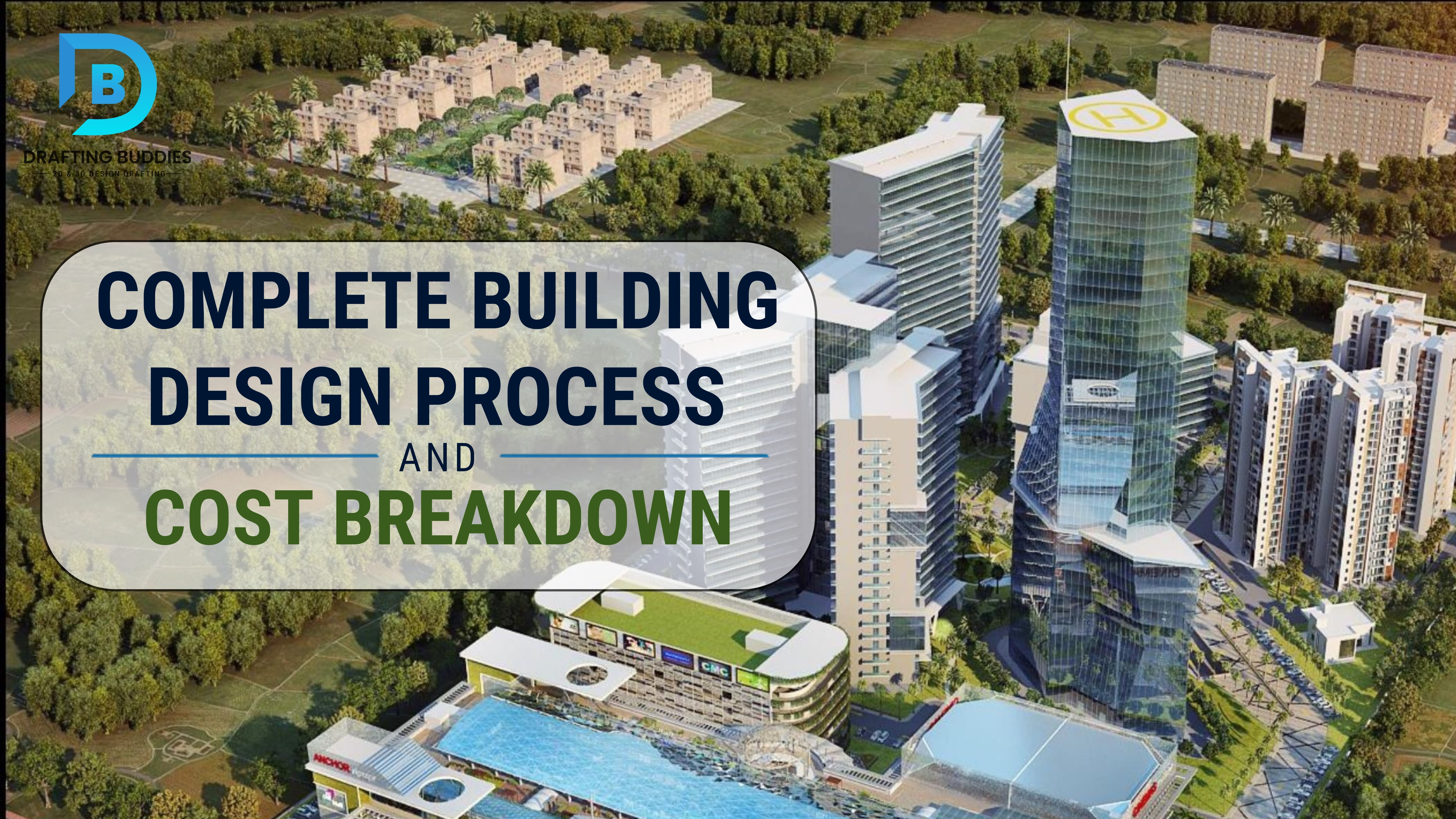
Building a structure in the United States - whether a $400K custom home in Austin or a $40M warehouse in New Jersey - follows a surprisingly consistent design process. Knowing the phases, the deliverables, and the cost at each stage puts you in control of your budget, your timeline, and your conversations with every professional on your team.
At DraftingBuddies, we've supported architects, developers, contractors, and owners on thousands of projects across all 50 states since 2014. This guide consolidates what we've learned - phase by phase, service by service - into one reference you can actually use.
7
Distinct design phases from concept to close-out
$1.8T
US construction put in place annually (Census Bureau)
40%
Of AEC firms now outsource some drafting or BIM work
Why the Building Design Process Matters More Than Ever
The National Institute of Building Sciences estimates that every $1 invested in pre-construction design saves $6-$20 in downstream construction costs. Despite that, many owners still view architectural drafting and construction drawing services as a line item to trim - until a permit rejection, a contractor RFI storm, or an expensive field change changes their mind.
The building design process is not a single event. It is a cascading sequence of decisions, each one reducing uncertainty and translating intent into buildable documents. Skipping or compressing a phase never eliminates the work - it just moves it into a more expensive location: the job site.
Real-World Example
A Texas-based developer in Dallas once skipped the design development phase on a 120,000 SF distribution center to save three weeks of schedule. The result: 43 RFIs in the first month of construction, $210,000 in change orders related to MEP coordination conflicts, and a 6-week delay. The design development phase would have cost roughly $28,000.
The 7 Phases of the Building Design Process
US practice, largely codified by the AIA's standard owner-architect agreement, breaks the design process into phases that move from broad to specific. Here is how they work in practice.
1
Pre-Design & Programming
Establish the project's purpose, occupancy, size, budget, and regulatory context. This includes zoning verification, site analysis, and building program documentation. Key deliverable: a written program or brief, not drawings. Duration: 1-4 weeks for most projects.
2
Schematic Design (SD)
The architect translates the program into the first spatial concept - rough floor plans, massing diagrams, and site plans. CAD drafting services are engaged here to convert hand sketches or concept models into clean 2D CAD drawings. 3D massing models are produced for owner review and early buy-in.
3
Design Development (DD)
SD drawings are refined into detailed architectural drawings - coordinated with structural and MEP systems. This is where architectural CAD drafting, structural CAD drafting, and MEP CAD drafting services all run in parallel. 3D modeling services may produce detailed BIM models for coordination. Deliverable: DD drawing set, outline specifications.
4
Construction Documents (CD)
The full permit and construction drawing set. This is the largest and most labor-intensive phase - typically 40-55% of total design fees. Deliverables include architectural floor plans, reflected ceiling plans, elevations, building sections, wall sections, details, schedules, and specifications. All disciplines coordinate here: architectural, structural, MEP, civil, and fire protection.
5
Permitting & Agency Review
Permit drawings - a subset of CDs - are submitted to the Authority Having Jurisdiction (AHJ). Most jurisdictions require architectural, structural, MEP, and civil drawings stamped by licensed professionals. Response times vary from 2 weeks (express review) to 6+ months in dense urban markets. Redline markups from the reviewing agency are addressed in this phase.
6
Construction Administration (CA)
The design team answers contractor questions (RFIs), reviews shop drawings and submittals from fabricators, issues supplemental instructions, and performs periodic site observations. Shop drawing services - for steel, glazing, millwork, precast, and other specialty systems - are a core part of this phase.
7
Post-Construction & As-Built Documentation
After construction is complete, as-built drawings - also called record drawings - document the project as it was actually built, incorporating all field changes. As-built floor plans, electrical as-built drawings, and mechanical as-built documents are required by most building owners for facilities management and future renovation work.
Full Cost Breakdown by Phase and Service Type
The ranges below reflect typical US market pricing for outsourced drafting, BIM, and visualization services in 2025-2026. Actual costs depend on project complexity, LOD requirements, turnaround time, and geographic market. Use these figures for budgeting and scope conversations - not as fixed quotes.
| Service / Phase | Residential | Commercial (Mid-Scale) | Industrial / Large | Notes |
|---|---|---|---|---|
| Architectural Drafting (2D CAD) | $1,500 - $6,000 | $8,000 - $40,000 | $30,000 - $150,000+ | Full SD → CD drawing set |
| 3D Modeling Services | $800 - $3,500 | $4,000 - $25,000 | $20,000 - $80,000 | BIM or standalone 3D model |
| 3D Architectural Rendering | $400 - $2,500 / view | $1,500 - $6,000 / view | $3,000 - $12,000 / view | Exterior + interior; animations extra |
| MEP Drafting Services | $1,200 - $5,000 | $12,000 - $60,000 | $50,000 - $200,000 | Mechanical, electrical, plumbing |
| Structural CAD Drafting | $800 - $4,000 | $6,000 - $35,000 | $25,000 - $100,000 | Foundation + framing plans |
| Civil Drafting Services | $1,500 - $5,000 | $8,000 - $45,000 | $30,000 - $120,000 | Site, grading, utilities, civil 3D |
| Permit Drawing Services | $500 - $2,500 | $2,000 - $12,000 | $8,000 - $35,000 | Stamped set for AHJ submittal |
| Shop Drawing Services | $500 - $2,000 | $3,000 - $20,000 | $15,000 - $80,000 | Steel, millwork, curtainwall, etc. |
| Steel Detailing Services | N/A | $5,000 - $30,000 | $25,000 - $150,000 | Connections, erection drawings |
| As-Built Drawings | $600 - $2,500 | $4,000 - $18,000 | $15,000 - $60,000 | Electrical, mechanical, architectural |
| PDF to CAD Conversion | From $150/sheet | From $120/sheet | From $90/sheet | Volume discounts available |
| Architectural Walkthrough Animation | $1,500 - $5,000 | $5,000 - $20,000 | $15,000 - $60,000 | 60-180 second fly-through video |
💡 Industry Benchmark: Design Fees as % of Construction Cost
AIA data suggests total design fees typically run 8-15% of construction cost for residential and 5-12% for commercial projects. A $2M commercial building should budget roughly $100K-$240K in total design and engineering fees across all disciplines. Outsourcing CAD drafting services can reduce this significantly without reducing quality.
Architectural CAD Drafting Services: What's Actually Included
When architects and developers talk about CAD drafting services, they are referring to the production of precise, scaled technical drawings using software like AutoCAD, Revit, MicroStation, or BricsCAD. These are not concept sketches - they are legal construction documents used to pull permits, price the work, and build the building.
What a Complete Architectural Drawing Set Contains
- Site Plans: Property boundaries, building footprint, parking, landscaping, utility connections
- Floor Plans (per level): Room dimensions, wall types, door/window locations, annotations
- Exterior Elevations: All four sides showing cladding, openings, grades, heights
- Building Sections: Cut-through views showing floor-to-floor heights, structural relationships
- Wall Sections & Details: Enlarged drawings of assemblies, connections, and transitions
- Reflected Ceiling Plans (RCP): Ceiling height changes, light fixture locations, soffits
- Schedules: Door, window, finish, and room schedules in tabular format
Real-World Example
A 6,800 SF multi-tenant retail strip center in Phoenix, Arizona required a 42-sheet CD set - architectural (18 sheets), civil (8 sheets), structural (9 sheets), and MEP (7 sheets) - to satisfy city permit requirements. Total CAD drafting and engineering drawing production: $52,000 across all disciplines. Timeline from SD kickoff to permit submittal: 11 weeks.
2D CAD DraftingBuilding PlansCAD Design ServicesResidential CAD DraftingConstruction Drawing ServicesAutoCAD Architectural Drafting
3D Modeling, Rendering & Visualization Services
Three-dimensional deliverables have moved from a “nice to have” into a project necessity for most building types. Owners use them to make decisions faster. Contractors use them to understand design intent. Marketing teams use them to pre-sell units or lease space before a shovel hits the ground.
Types of 3D Services and When to Use Each
3D Massing Model
Simplified volumetric model used in early schematic design for owner review and planning approvals. Quick to produce; no material detail. Ideal for feasibility and community presentations.
BIM / Revit Model
Full parametric 3D building model with embedded data for all building elements. Used for MEP coordination (clash detection), quantity takeoffs, and facility management. Industry standard on commercial projects over $5M.
Photorealistic Rendering
High-resolution still images (exterior + interior) with materials, lighting, and context. Critical for developer marketing, investor decks, and pre-leasing. Typically produced from Lumion, Enscape, or V-Ray.
Virtual Walkthrough
Animated fly-through video or interactive real-time tour. Used for luxury residential, hospitality, and mixed-use projects. 3D architectural walkthrough videos typically run 60-180 seconds and are hosted on project websites.
Real-World Example
A multifamily developer in Nashville used 3D architectural rendering services to produce 6 exterior views and 4 interior views of a 220-unit apartment project before the foundation was poured. The renderings were used to secure $3.2M in pre-leasing commitments. Total rendering cost: $18,400. ROI: immediate.
MEP Drafting Services: Mechanical, Electrical & Plumbing
MEP systems - mechanical (HVAC), electrical, and plumbing - represent 25-40% of total construction cost on most commercial buildings. The drawings that define these systems are among the most complex and coordination-intensive in the entire drawing set.
What MEP Drawing Services Include
- HVAC Layout Drawings: Duct routing, equipment schedules, diffuser locations, static pressure calcs
- HVAC Drafting Services: Equipment connections, VAV box layouts, AHU submittals
- Electrical Drafting Services: Panel schedules, single-line diagrams, lighting plans, load calculations, electrical wiring diagrams
- Electrical Schematic Design: Power distribution, emergency systems, low-voltage schematics
- Plumbing Drawings: Fixture schedules, riser diagrams, waste/vent plans, domestic water piping
- MEP BIM Coordination: Clash detection between duct, pipe, conduit, and structural members using Navisworks or Revit MEP
- MEP Shop Drawing Services: Fabrication-ready duct shop drawings, prefabricated plumbing rack drawings
Why MEP Coordination Saves Real Money
A 2023 Dodge Data & Analytics study found that buildings using BIM for MEP coordination experienced 40% fewer RFIs during construction and 22% lower MEP installation costs compared to 2D-only coordination. On a $5M MEP scope, that's $1.1M in savings.
Shop Drawing Services: The Fabricator's Bridge to the Field
Shop drawings are not produced by the architect - they're produced by the specialty contractor or fabricator and then submitted to the design team for review. They show exactly how a specific product or system will be manufactured and installed. Getting them right is critical; getting them wrong halts work on a job site.
Common Shop Drawing Submittals
- Steel Shop Drawing Services: Connections, base plates, anchor bolt patterns, erection sequences for structural steel
- Structural Steel Detailing Services: Member sizes, weld specifications, bolt schedules to AISC standards
- Curtainwall / Glazing Shop Drawings: Mullion profiles, glass sizes, anchor details, sealant joint specifications
- Millwork & Casework: Custom cabinet, countertop, and built-in furniture fabrication drawings
- Precast Concrete Shop Drawings: Panel layouts, embed locations, hardware schedules
- Metal Works Drafting Services: Railings, stairs, canopies, ornamental metalwork
Real-World Example
A steel fabricator in Houston contracted DraftingBuddies to produce shop drawings for a 38,000 SF industrial building's structural steel package - 147 unique members, 43 connection types. We delivered 62 fabrication drawings in 9 business days. The GC reported zero field RFIs related to steel installation.
Permit Drawing Services & As-Built Documentation
Two sets of drawings bookend every construction project: permit drawings at the front end and as-built drawings at the close. Both are often underestimated - and both have serious consequences when neglected.
Permit Drawing Services
Permit drawings are a coordinated set of construction documents formatted and organized to meet the specific requirements of the local building department. Requirements vary by jurisdiction but typically include:
- Cover sheet with code compliance matrix (IBC, IRC, local amendments)
- Site plan with setbacks, easements, and utility connections
- Architectural floor plans, elevations, and sections
- Structural drawings stamped by a licensed PE
- MEP drawings (mechanical, electrical, plumbing) with energy compliance documentation
- Accessibility compliance notes (ADA / Fair Housing)
- Life safety and egress plans
As-Built Drawings
As-built drawings (also called record drawings) document the project as it was actually constructed. Field conditions, material substitutions, routing changes, and structural modifications are all reflected in the final record set. Electrical as-built drawings are particularly important for future maintenance and renovation work - knowing where a circuit actually runs is worth more than knowing where it was designed to run.
Owners of multi-tenant commercial properties, government facilities, and healthcare buildings are typically required by contract or code to maintain current as-built documentation.
Outsourcing CAD Drafting Services: What US Firms Are Doing
Over the past decade, outsourcing CAD drafting services has moved from an edge-case cost-reduction tactic into a mainstream delivery strategy for US architecture, engineering, and construction firms. Here is the business case as it actually plays out.
Why Firms Outsource
- Capacity without overhead: Hiring a full-time AutoCAD drafter in Texas costs $55,000-$85,000/year in salary alone, plus benefits and software licenses. Outsourced CAD drafting services can provide the same output at a fraction of the cost, scaled up or down per project.
- Speed: A specialized drafting firm works on your drawings across time zones - what you hand off at 5 PM is ready for review at 8 AM.
- Software breadth: A professional drafting company maintains current licenses across AutoCAD, Revit, MicroStation, Civil 3D, and SolidWorks - no capital expense for your firm.
- Specialization: Steel shop drawing services, MEP BIM coordination, and 3D scan to CAD conversion are specialized skills that few in-house teams maintain at full capacity year-round.
What to Look For in a CAD Drafting Company
- US-based project management and QA, even if production is distributed
- Demonstrated experience with your project type (residential, commercial, industrial)
- Familiarity with local code requirements and AHJ preferences
- Clear revision and redline markup handling process
- NDA and IP protection policies
Real-World Example
A 12-person architecture firm in Chicago outsourced all construction document production for a 44-unit multifamily building in Denver to DraftingBuddies. The firm's in-house team handled design and client communication; we handled CD production - 94 sheets across architectural, structural, and MEP disciplines. The project delivered 3 weeks ahead of the firm's original in-house schedule.
Outsource CAD DraftingRemote Drafting ServicesCAD Outsourcing ServicesProfessional Drafting USA3D Scan to CADPDF to CAD ConversionBIM Coordination
Choosing the Right Services for Your Project Stage
Not every project needs every service. Here is a simplified decision guide based on project type and phase.
New Construction (All Types)
Full drafting scope: architectural 2D drafting, 3D modeling, MEP CAD drafting, structural, civil, permit drawings, and shop drawings during CA.
Renovation / Tenant Improvement
Start with as-built drawings of existing conditions. Then SD → CD for changes only. Often excludes civil; MEP scope varies by extent of change.
Residential Design-Build
Floor plan drafting, structural, permit drawings. 3D rendering for marketing. Minimal MEP on small residential; full MEP on custom homes over $800K.
Prefab / Steel Fabrication
Steel shop drawing services, structural steel detailing, fabrication drawings. Often no architectural scope - pure structural and connection detailing.
Ready to Start Your Building Design Project?
DraftingBuddies has delivered CAD drafting, 3D modeling, MEP coordination, and shop drawing services to clients in all 50 states since 2014. Tell us about your project and we'll scope it for you - usually within 24 hours.
Get a Free Project QuoteRecent Blogs
FAQs:
You Ask, We Draft