AutoCAD remains foundational, especially for civil, electrical, and mechanical work in 2D. But AutoCAD and 3D capability through Civil 3D, AutoCAD Plant 3D, or AutoCAD's native 3D tools is increasingly expected alongside it. Firms are phasing out 2D-only workflows gradually over 2-3 years, not overnight.
Why 3D Modeling is Required in US Construction Projects
3D modeling is now a mandatory requirement for many large U.S. construction projects, driven by federal agencies and major developers. It improves coordination, reduces errors, and lowers costs compared to traditional 2D CAD workflows.
BIM and 3D models enable clash detection, accurate planning, and better communication between all project teams. New AI tools like Text to CAD and Image to CAD are also making modeling faster and more efficient.
Firms that adopt 3D workflows stay competitive and eligible for large-scale projects, while those using only 2D CAD risk falling behind.
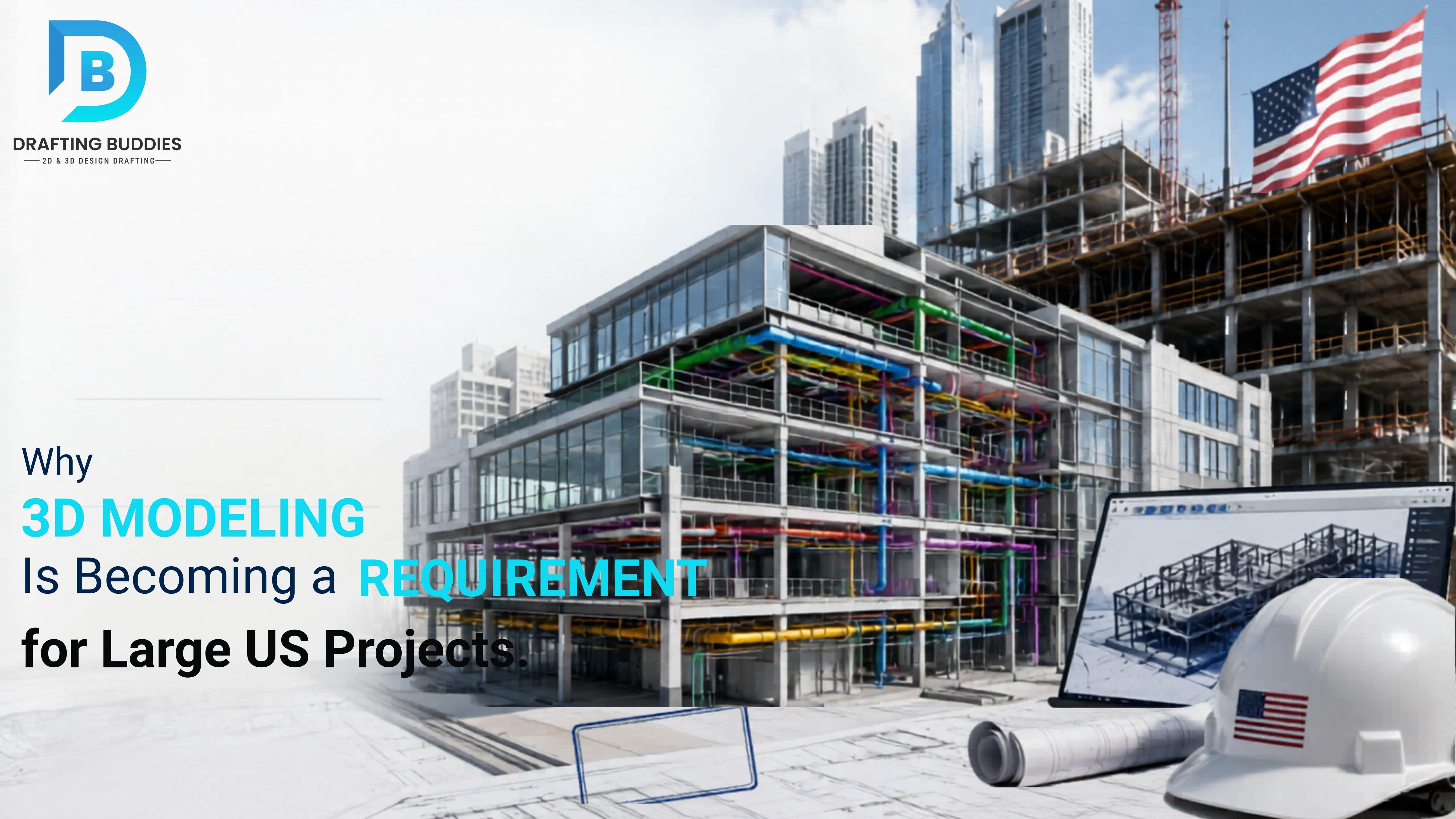
Let's be direct: the construction and engineering landscape in the United States has changed dramatically over the last three years. What used to be a competitive edge, submitting a polished CAD 3D modeling package alongside your traditional drawing set, is now a baseline expectation on projects over $10 million. Federal infrastructure programs, state transportation departments, and major commercial developers are writing 3D CAD deliverables directly into their RFP requirements. Not optional. Not preferred. Required.
So what changed? And what does it mean for firms, freelancers, and engineers who are still building their workflows around flat CAD drawing sets?
Owners, contractors, and municipalities have discovered that 3D modeling for buildings and infrastructure helps reduce one of the most expensive problems in large-scale construction: miscommunication between design intent and field execution. When clash detection, quantity takeoffs, phasing simulations, and permit reviews all run off the same 3D model, the cost savings justify the upfront investment within months. The US Army Corps of Engineers, the General Services Administration, and the vast majority of state DOTs now mandate some level of BIM or 3D CAD deliverable. If your firm isn't fluent in it, you simply cannot bid.
Why Owners Are Demanding It: The Business Case in Plain Numbers.
The shift isn't philosophical. It's financial.
A 2024 report from the Construction Industry Institute found that projects using coordinated 3D designs from preconstruction through closeout reduced RFIs by an average of 38% and change orders by nearly 30%. On a $50 million hospital expansion, that's real money. Owners have seen the data, and they're not going back.
Here's where it gets practical. When a structural engineer produces a column grid in AutoCAD and 3D, the MEP coordinator can run their ductwork model through the same space in real time. Collisions that would have surfaced as expensive field conflicts in week eight of construction get caught in week two of design at a fraction of the cost. That's not a theoretical benefit. That's what the best CAD design workflows are delivering on active job sites right now.
Example
California High-Speed Rail Authority: Every design package submitted to CHSRA must include 3D corridor models at a minimum LOD 300. Firms that couldn't deliver were disqualified from shortlisting regardless of their 2D experience or project history.
NYC Department of Design and Construction. Since 2023, DDC has required BIM execution plans built around central 3D CAD models for all new construction projects over $15 million. Their reasoning: a shared model reduces document translation errors between architect, structural, and MEP teams that historically cost the city tens of millions annually.
The pattern repeats across Texas, Florida, Illinois, and Washington State. The question isn't whether your region will get here. It's whether you'll be ready when it does.
These tools are still evolving and work best as assistive technologies, not replacements
This is where the conversation gets interesting for anyone who thinks of auto 3D model workflows as a future concept. They're not the future. They're in production shops right now, and they're changing how modeling hours get allocated.
Text to CAD
Text to CAD tools allow users to describe geometry, components, or even full assemblies in natural language and receive a parametric 3D model or a CAD drawing as output. A structural engineer can type "steel W-shape column, W14x90, 18 feet tall, base plate 14x14x1.5, with four anchor bolts at 10-inch spacing," and a production-ready model comes back in seconds. The best implementations integrate directly with Revit, Civil 3D, and SolidWorks, meaning the output drops into an existing project environment rather than requiring import cleanup.
For large US projects, the efficiency gain is clearest in repetitive elements: parking structures, precast concrete systems, and curtain wall mullion layouts. Tasks that used to consume a junior drafter's entire week can now be batch-generated in an afternoon.
Image to CAD
Image to CAD tools convert a photograph, a sketch, or even a scanned legacy drawing into an AutoCAD sheet and produce a working 3D CAD model from it. The technology is genuinely useful for renovation and adaptive reuse work, where existing building documentation is incomplete or was never digitized. A field photo of a mechanical room can be converted into a point-cloud-informed 3D model maker output, which is then cleaned up and integrated into the project BIM.
This has become particularly valuable for federal historic preservation projects, where original construction documents may be on vellum in an archive, and converting them manually would take months.
AI-Assisted Clash Detection and Code Compliance
Modern 3D modeling & CAD platforms, including the latest builds of Revit and Navisworks and newer entrants like Monograph and Arcol, use AI to flag not just geometry clashes but also code compliance issues in real time. A column placement that violates egress clearance requirements in IBC 2024 gets flagged before the drawing set is even issued for review.
This is the part of the workflow that agencies like GSA and HUD find most compelling: it means fewer revision cycles, faster permit turnaround, and better coordination with the Authority Having Jurisdiction.
The 3D Model Sites and Asset Libraries Accelerating All of This
Platforms like Revit's built-in content libraries, BIMObject, and Trimble's MEP content networks have turned 3D model creator work into a matter of assembly rather than from-scratch drafting. Standard equipment VAV boxes, fire suppression heads, and structural connectors come as certified manufacturer content with embedded specification data. A designer using these 3D model sites can populate a mechanical room in hours instead of days.
What Gets Automated and What Doesn't
Here's a fear many experienced professionals have, and it deserves a straight answer: AI and automation will not replace skilled 3D and BIM professionals in AutoCAD on large US projects. Here's why.
What automation handles well:
- Generating repetitive geometry from spec input (Text2CAD)
- Converting legacy drawings or photos into base models (Img2CAD)
- Running clash detection across disciplines
- Producing quantity takeoff reports from model data
- Generating standard detail libraries from manufacturer specs
- Producing construction phase simulations from schedule data
What still requires human expertise and always will on complex projects:
- Design intent decisions that balance cost, aesthetics, constructability, and code
- Coordination meetings where the model is the communication tool, not the answer
- Site-specific problem solving (soil conditions, existing structure quirks, utility conflicts)
- Client relationship management around design iterations
- Regulatory agency presentations using the 3D designs as visual testimony
- Value engineering sessions where a skilled modeler reworks geometry to hit a budget number
The professionals winning on large US projects right now aren't the ones who avoid AI tools; they're the ones who use them to eliminate low-value hours and redirect that time toward high-judgment work that no model can produce on its own.
Career Positioning and What Firms Should Do Right Now
For Individual Professionals
If you're currently strong in drawing, AutoCAD, and 2D production, your next investment should be learning 3D in AutoCAD (for civil and infrastructure work) or Revit/Rhino (for building design). You don't need to abandon your existing skills. You need to extend them into the third dimension and understand how a 3D model functions as a living project document rather than a static deliverable.
Specific certifications worth pursuing in 2026: Autodesk Certified Professional in Civil 3D, Revit Architecture, or Revit MEP. The GSA's BIM Guide Series is free online and is effectively the professional literacy test for federal project work.
Get comfortable with at least one of the major 3D model maker platforms for your discipline. Experiment with Text2CAD tools during low-stakes hours to understand where they save time and where they still need guidance.
For Firms
The firms positioning themselves well are doing three things:
- 1. Building a model management workflow, not just a modeling capability. Anyone can put a seat of Revit in a drafter's hands. Fewer firms have a real Common Data Environment, a disciplined LOD progression protocol, and clear handoff standards between design phases. That's the actual differentiator on large projects.
- 2. Investing in training for mid-level staff, not just hiring new graduates. Your experienced project managers who understand field conditions and owner relationships are invaluable. Help them get fluent in reading and coordinating from a 3D design environment rather than paper.
- 3. Starting small. If you haven't made the full jump yet, pick one project in the $5–15M range and execute it as a full BIM/3D project. Use it as a controlled environment to build your workflow, identify your gaps, and develop your standard templates. Then scale.
Conclusion
The shift toward 3D modeling as a project requirement on large US work isn't coming—it's here. Federal agencies, major municipalities, and sophisticated private owners have made their expectations clear in RFPs, contract language, and procurement scoring. The technology from 3D CAD platforms to AI-powered 3D model creator tools, Text2CAD, and Img2CAD workflows now makes high-quality 3D designs achievable for firms of almost any size.
What separates the firms and professionals winning in this environment isn't just software fluency. It's understanding how a 3D model functions as the project's central source of truth and building every workflow, meeting, and deliverable around that reality.
The best time to start was two years ago. The second-best time is your next project.
Recent Blogs
FAQs:
You Ask, We Draft