How Metro Rail Projects Use Drafting and BIM Technology
Metro rail projects depend on a combination of CAD drafting and BIM technology to manage their extreme design complexity. While CAD drafting provides accurate 2D drawings for alignments, stations, structures, and MEP systems, BIM integrates all disciplines into a coordinated 3D model. This enables clash detection, quantity takeoffs, construction sequencing (4D), cost control (5D), and long-term asset management (6D).
Overall, BIM and drafting together help metro projects reduce errors, control costs, and deliver large-scale
transit systems more efficiently and safely.
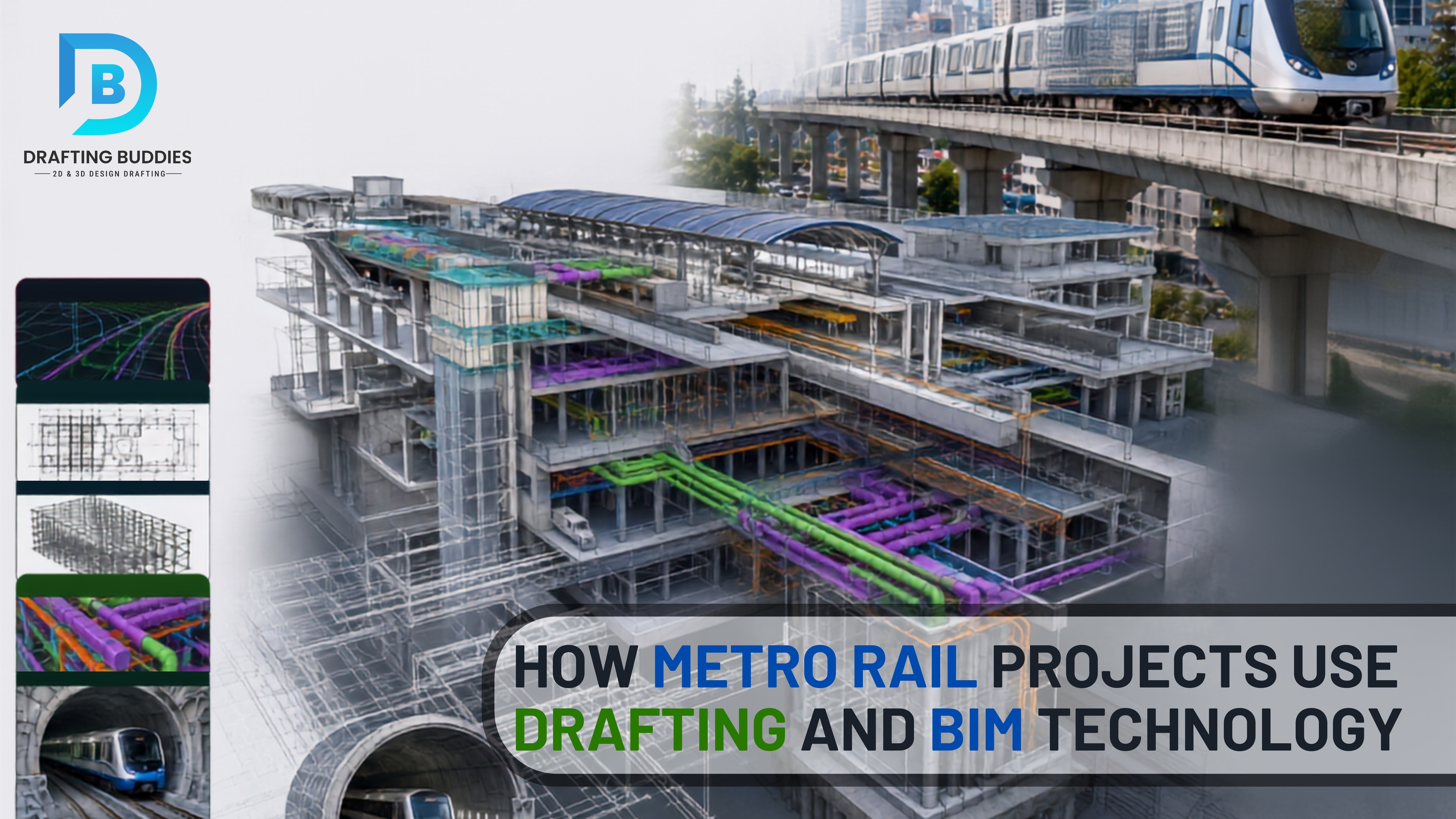
Metro rail systems look simple from the outside. You stand on a platform, the train arrives, you get on, and you get off. But behind every metro line, every tunnel, station, viaduct, and signal box, thousands of drawings, models, and design files made it possible to build safely, on budget, and on time.
This is where Metro Rail BIM and rail CAD drafting come in. Metro rail projects are some of the most complex infrastructure builds in the world, involving underground tunnels, elevated tracks, stations, depots, power systems, and signaling, all of which have to work together without a single clash. A small design error underground can cost millions to fix once construction has already started. That's why metro authorities and contractors now rely on railway BIM modeling, rail infrastructure BIM, and detailed railway drafting services at every stage of a project.
In this blog, we'll break down exactly how drafting and BIM technology are used in metro rail projects, what software powers this work, the data behind why it matters, and where the industry is heading next.
Why Metro Rail Projects Need More Than Just "Drawings"
A metro rail project isn't a single structure; it's a network of structures. A typical project includes:
- Underground tunnels and cut-and-cover sections
- Elevated viaducts and bridges
- Stations (underground, at-grade, and elevated)
- Depots and maintenance yards
- Track alignment and trackwork
- Electrical and signaling systems
- Mechanical, ventilation, and fire safety systems
- Utility lines that need to be relocated or protected
Every one of these components has its own engineering discipline, and all of them need to be coordinated in 3D space, often in incredibly tight underground or urban environments. This is exactly why traditional 2D drawings alone are no longer enough and why BIM for rail projects has become the standard approach for modern transit infrastructure.
1. Rail CAD Drafting: The Foundation of Metro Rail Design
Even with BIM dominating the conversation, rail CAD drafting still plays a critical role in metro rail projects. Drafting services are used for:
- Alignment drawings: Precise horizontal and vertical alignment of the rail corridor, including curves, gradients, and clearances, all drawn to exact engineering tolerances.
- Metro station drafting: floor plans for concourse levels, platform levels, entry/exit points, and emergency egress routes.
- Structural drawings: Detailed drawings of columns, beams, slabs, tunnel linings, and viaduct sections that contractors use directly on site.
- MEP drawings: drafting for ventilation shafts, drainage, fire protection, and electrical conduit routing throughout stations and tunnels.
- Railway shop drawings: Fabrication-level drawings for steel structures, platform screen doors, signal gantries, and other prefabricated components that need exact dimensions before manufacturing.
These drawings act as the legal and technical reference point for contractors, fabricators, and inspection teams throughout construction, and they remain a core part of any rail design services package even on heavily BIM-driven projects.
2. Railway BIM Modeling: Bringing the Entire Project Into One 3D Environment
BIM takes everything in a metro rail project, structural, architectural, MEP, and civil, and combines it into a single coordinated 3D model. This is a massive shift from the old way of working, where each engineering team designed in isolation and clashes were only discovered on-site, often too late.
Here's what railway BIM modeling actually does for metro rail projects:
- Clash detection: Before a single shovel hits the ground, BIM software checks whether a ventilation duct collides with a structural beam or whether a signaling cable tray runs straight through a drainage pipe. Catching these clashes digitally is far cheaper than catching them on-site. Industry studies on clash detection in large infrastructure projects have found that resolving conflicts during design rather than construction can save up to 20% of total contract value, since fixing the same issue in the field can cost many times more than fixing it in the model.
- 4D scheduling: BIM models can be linked to project timelines, so stakeholders can visually see how construction will progress month by month, station by station.
- Quantity takeoffs: Because BIM models are data-rich, accurate material quantities (concrete, steel, cabling, etc.) can be extracted directly from the model, improving cost estimation and procurement.
- Underground utility coordination Metro tunnels often run beneath existing roads, buildings, and utility lines. BIM allows teams to map existing underground infrastructure and plan tunnel routes that avoid costly utility relocations.
- As-built documentation Once construction is complete, the BIM model is updated to reflect exactly what was built, giving the metro authority a digital twin for future maintenance and expansion.
This combination of infrastructure BIM services and traditional drafting is what allows large transit authorities to manage thousands of interconnected drawings without losing coordination.
3. Coordination Between Multiple Engineering Teams
A metro rail project usually involves dozens of design and engineering firms working at the same time, including civil contractors, structural consultants, signaling specialists, electrical engineers, and architects. Without a shared digital model, each team would be working off separate drawing sets, and conflicts would only surface during construction.
BIM solves this by giving every team access to a shared coordinated model (often called a federated model). Each discipline's model is layered on top of the others, allowing project managers to spot conflicts early and assign responsibility for fixes before construction begins.
This is especially valuable for elevated metro corridors, where structural, architectural, and MEP elements are extremely close together, and even a few centimeters of clearance error can create real problems on-site.
4. Tunnel BIM Modeling and Underground Stations
Underground metro stations are some of the most technically demanding structures to design. They typically involve multiple levels stacked vertically: concourse, mezzanine, and platform, all within a confined excavation. Tunnel BIM modeling and detailed drafting are used to design:
- Excavation support systems (diaphragm walls, shoring)
- Tunnel boring machine (TBM) alignment and segment design
- Cross-passages and emergency escape routes
- Ventilation shafts and smoke extraction systems
- Waterproofing details at every structural joint
Because underground construction is largely invisible once finished, getting the drafting and BIM coordination right the first time is non-negotiable. There's no easy way to "open up" a finished tunnel to fix a clash later.
5. Depots, Yards, and Maintenance Facilities
Metro rail systems aren't just about moving trains from point A to point B; they also need depots and maintenance yards where trains are stored, cleaned, inspected, and repaired. These facilities require their own detailed transit infrastructure modeling, including:
- Track layout and switch design within the yard
- Workshop and inspection pit drawings
- Overhead crane and lifting equipment coordination
- Stormwater drainage and site grading plans
- Administrative building architectural drawings
Depot design is often treated as a mini-project of its own, with the same level of drafting precision as the main rail corridor.
6. Common Software Used in Metro Rail Projects
Metro rail design teams typically rely on a stack of specialized software rather than a single tool, since civil, structural, MEP, and rail-specific systems all need different modeling environments. Common software includes:
- Autodesk Revit: used for architectural, structural, and MEP BIM modeling of stations, depots, and ancillary buildings
- Autodesk Civil 3D: used for alignment design, corridor modeling, grading, and earthworks along the rail route
- Bentley OpenRail / OpenRoads is widely used by rail-specific design teams for track alignment, signaling layout, and rail corridor modeling
- Autodesk Navisworks: used heavily for federated model coordination and clash detection across disciplines
- Tekla Structures is used for detailed structural and rebar modeling, especially for tunnels, viaducts, and precast elements
- AutoCAD: still widely used for 2D drafting, shop drawings, and detail sheets that contractors take directly to the site
- BIM 360 / Autodesk Construction Cloud is used for cloud-based model sharing, version control, and issue tracking across project stakeholders
Most large metro authorities now specify a defined software environment and BIM execution plan at the start of a project, so every consultant and contractor works in a compatible format.
7. Understanding BIM Levels (LOD 100–500) in Rail Projects
Not every BIM model needs the same level of detail at every stage. Metro rail projects typically follow standard levels of development (LOD):
- LOD 100 Conceptual massing, used for early feasibility and route planning
- LOD 200: Approximate geometry and quantities, used for preliminary design and budgeting
- LOD 300: Precise geometry suitable for coordination and clash detection, typically used at the detailed design stage
- LOD 350 adds interface detail between disciplines, critical for tight tunnel and station coordination
- LOD 400 Fabrication-level detail, used for shop drawings and prefabricated components
- LOD 500 As-built verification, used for handover and long-term facility management
Defining the right LOD at each project phase prevents teams from over-modeling early (wasting time) or under-modeling late (missing critical clashes).
8. Scan to BIM and Point Cloud Modeling for Existing Rail Corridors
Many metro projects involve extending an existing line, retrofitting an old station, or building new infrastructure near existing rail corridors, utilities, or heritage structures. In these cases, design teams use Scan-to-BIM workflows:
- Laser scanning (LiDAR) captures the existing site as a dense point cloud
- The point cloud is converted into an accurate 3D BIM model of existing conditions
- New design elements are modeled directly against this verified baseline, instead of relying on outdated as-built drawings
This is especially valuable for brownfield metro extensions, where existing tunnels, platforms, or utility corridors may match the original drawings after years of modifications.
9. Drone Surveys and GIS + BIM Integration
For above-ground sections of elevated viaducts, depots, and station precincts, drone surveys are increasingly used to capture topographic data quickly and safely, especially across long, linear corridors that would take weeks to survey manually.
This survey data is then combined with GIS (Geographic Information System) data through GIS + BIM integration, allowing teams to:
- Overlay the rail alignment on real-world terrain, land parcels, and zoning data
- Coordinate with city planning departments using a shared geospatial reference
- Identify environmentally sensitive areas, flood zones, or heritage sites early in design
GIS handles the "where in the world" context, while BIM handles the "exactly how it's built" detail. Together, they give planners a much more complete picture for corridor selection and risk assessment.
10. 4D, 5D, and 6D BIM in Metro Rail Projects
BIM isn't limited to 3D geometry. Metro rail projects increasingly use extended BIM dimensions:
4D BIM (construction sequencing) links the 3D model to the project schedule so teams can simulate and visualize how construction will phase across multiple stations and corridor sections simultaneously.
5D BIM (cost estimation) connects the model to cost data, allowing real-time budget tracking as design changes are made, instead of waiting for a full re-estimate.
6D BIM (asset management) embeds equipment data, maintenance schedules, and lifecycle information into the model, which is handed over to the metro operator for long-term facility and asset management after the line opens.
These dimensions are what turn BIM from a design tool into a tool that supports the entire lifecycle of the railway, from planning through decades of operation.
11. Rail Signaling Coordination and Utility Mapping
Two of the most clash-prone elements in any metro project are signaling systems and underground utilities, and both require dedicated coordination effort:
- Rail signaling coordination: Signaling cable routes, equipment rooms, and trackside cabinets need to be modeled alongside structural and MEP elements to avoid conflicts, especially in tunnels and underground stations where space is extremely limited.
- Utility mapping: Before any excavation begins, existing utilities (water, gas, power, telecom, drainage) along the corridor must be surveyed and mapped into the BIM environment. Inaccurate utility mapping is one of the most common causes of construction delays and cost overruns on urban metro projects.
12. Prefabrication Using BIM
Because BIM models are dimensionally accurate and clash-checked, they're increasingly used to drive prefabrication strategies for metro projects: precast tunnel segments, platform screen door assemblies, modular station components, and prefabricated MEP racks. Coordinated BIM data feeds directly into fabrication drawings, which means components arrive on-site ready to install rather than needing on-site adjustment. This shift toward offsite fabrication is one of the main ways BIM-coordinated projects reduce field labor and construction timelines.
13. Sustainability and AI in Railway BIM
Two trends are increasingly shaping how metro rail design teams work:
Sustainability in metro design: BIM models are now used to run energy analysis on stations, evaluate natural ventilation and daylighting strategies, and calculate embodied carbon in structural materials, helping metro authorities meet environmental targets without redesigning late in the process.
AI in railway BIM: Artificial intelligence is starting to assist with automated clash detection prioritization, generative design options for station layouts, and predictive maintenance modeling using data from 6D BIM asset models. While still an emerging area, AI-assisted BIM workflows are expected to play a much larger role in how large rail authorities manage design review and long-term asset data.
14. BIM Standards: ISO 19650 and Why They Matter
Most large metro rail projects now require compliance with ISO 19650, the international standard for managing information over the lifecycle of a built asset using BIM. ISO 19650 defines:
- How information is structured, named, and exchanged between teams
- Roles and responsibilities for information management across the project
- How models are validated and approved before being shared with other disciplines
For metro authorities running multi-billion-dollar, multi-decade projects with dozens of contractors, a shared standard like ISO 19650 is what keeps thousands of files, models, and revisions from turning into chaos.
15. Common Challenges in Metro Rail BIM Projects
Even with BIM and accurate drafting, metro rail projects face recurring challenges:
- Legacy data gaps: Older lines often have incomplete or inaccurate as-built drawings, making retrofits and extensions harder to model accurately
- Multi-stakeholder coordination: Government authorities, contractors, consultants, and utility owners all need to work from the same model without version conflicts
- Underground uncertainty: Soil conditions, undocumented utilities, and unforeseen obstructions can still surface during construction despite thorough BIM coordination
- Software interoperability: Different disciplines often use different software platforms, requiring careful file format management to keep federated models accurate
- Skilled resource availability: Experienced BIM modelers and rail drafters who understand both the software and rail engineering standards can be hard to scale up quickly on large projects
Working with an experienced drafting and BIM partner helps reduce the impact of these challenges, since established teams already have the workflows and quality checks in place to catch problems early.
16. Why BIM and Drafting Reduce Cost and Delay Risk
Metro rail projects are public infrastructure, which means cost overruns and delays are highly visible and politically sensitive. The biggest cause of both is usually design errors discovered mid-construction. BIM and accurate drafting reduce this risk in a few clear ways:
- Fewer site surprises and clash detection in the model mean fewer "stop work" moments on-site.
- Better contractor coordination Clear, coordinated drawings mean less back-and-forth between contractors and consultants.
- Faster approvals. Many metro authorities now require BIM submissions for permit and design review, since reviewers can interrogate the model directly instead of cross-checking dozens of 2D sheets.
- Long-term asset management Once the line is operational, the BIM model becomes a digital record used for maintenance planning, renovations, and future line extensions.
17. The Growing Role of Digital Twins in Metro Rail
Many metro authorities are now going one step further by turning their BIM models into living digital twin models that stay updated even after construction, reflecting real-time sensor data, maintenance records, and structural health. Digital twins are increasingly viewed as the standard approach for long-term infrastructure asset management on major transit systems, since they let operators simulate maintenance scenarios, track asset condition, and plan future expansions virtually before any physical work happens.
This is the direction metro rail design is heading globally, and it starts with the same foundation: accurate drafting and well-coordinated BIM models built during the design and construction phase.
Final Thoughts
Metro rail projects are a perfect example of why drafting and BIM technology matter so much in modern infrastructure. With so many disciplines, so much underground complexity, and so little room for error, relying on outdated 2D-only workflows simply isn't realistic anymore.
From alignment drawings and railway shop drawings to fully coordinated federated BIM models, LOD-driven design stages, and digital twins, drafting and BIM give metro rail teams the ability to design with precision, catch problems before they become expensive, and deliver projects that serve cities for decades.
About Drafting Buddies
Since 2014, Drafting Buddies has supported architects, engineers, contractors, and infrastructure teams with CAD drafting, BIM modeling, shop drawings, construction documentation, and coordination services across all 50 US states. Our team works across residential, commercial, and infrastructure projects, helping firms deliver accurate, coordinated drawings without the overhead of building an in-house drafting department.
If your firm is working on metro rail, transit, or any large-scale infrastructure project and needs reliable rail CAD drafting or railway BIM modeling support, get in touch with Drafting Buddies to see how we can support your next project.
Need Metro Rail BIM or CAD Drafting Support?
DraftingBuddies has delivered CAD drafting, BIM modeling, and coordination services to infrastructure teams across all 50 states since 2014. Tell us about your metro rail or transit project and we'll scope it for you - usually within 24 hours.
Get a Free Project QuoteRecent Blogs
FAQs:
You Ask, We Draft