Why Concrete is Making a Comeback in Modern American Architecture
Concrete is making a strong comeback in modern American architecture, not as a cold, outdated material but as a versatile and design-driven choice. Once associated with heavy and unappealing structures, concrete is now being used in more refined, textured, and visually appealing ways. Advances in finishes like polished, stained, and decorative concrete have transformed its look, while strong market demand in both residential and commercial construction shows its growing relevance. From foundations to high-end design elements, concrete offers durability, flexibility, and cost efficiency. The shift is not just about style but about recognizing the true value of a material that was never the problem, only misunderstood.
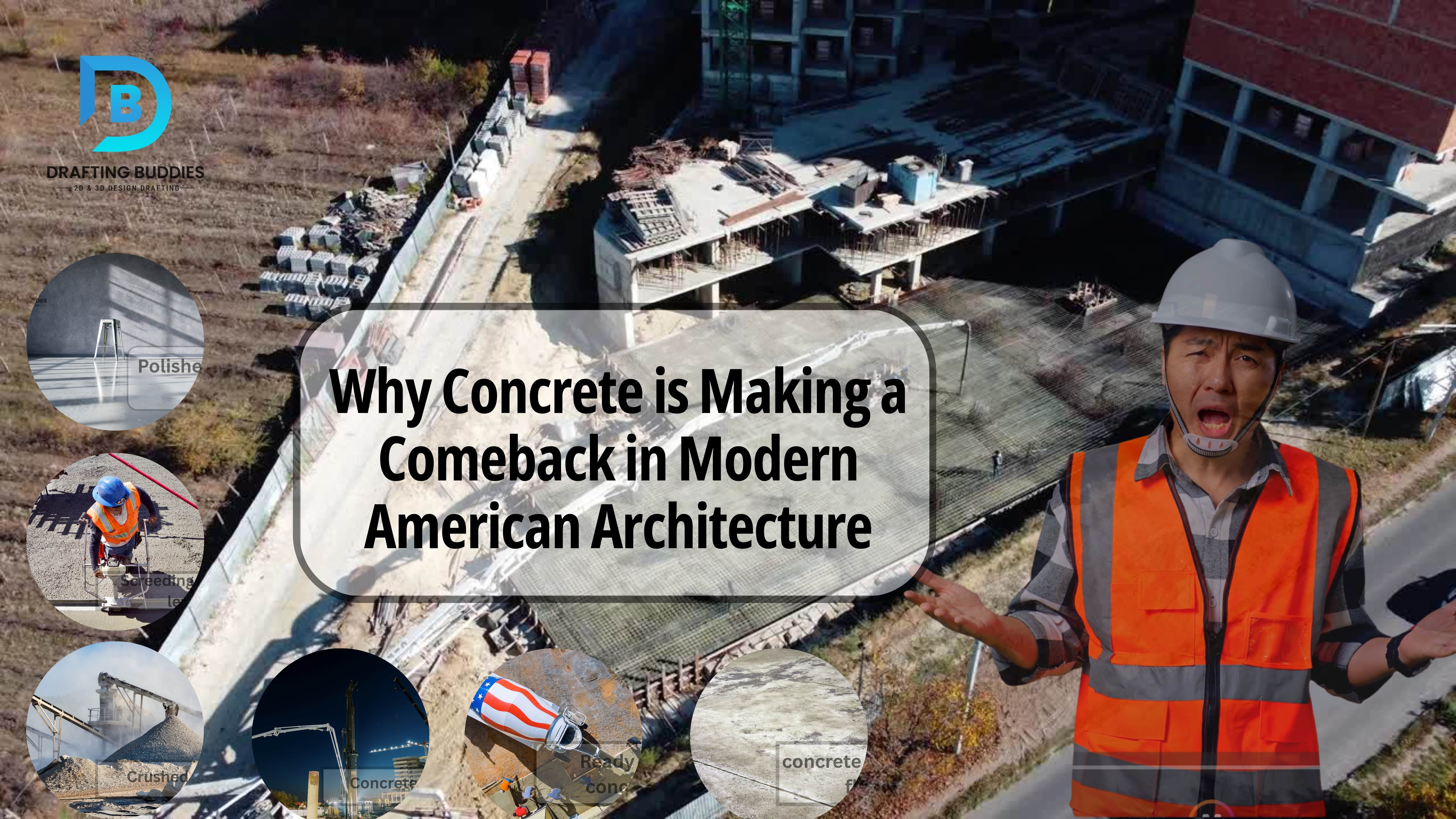
I want to start with something I noticed while driving through Salt Lake City about two years ago.
A new building had gone up on a street I drive past pretty regularly. And unlike everything else going up around it, the glass boxes, the beige stucco apartment blocks, the cladding that looks like it was chosen from a catalog, this one was different. It had a raw concrete facade. Board-formed, textured, almost monolithic in style, confident and unrefined. And I remember thinking, That is actually beautiful.
I have been in architectural drafting and 3D rendering for over a decade. I have drawn more floor plans, elevation drawings, and concrete slab foundations than I can count. I have rendered polished concrete floors so many times that I could do it in my sleep. And even I was a little surprised by how good that building looked.
That moment stuck with me. Because it was not the only one, these days, everywhere I look, concrete is showing up in places and ways it simply was not ten years ago. Not grey and cold and apologetic. Confident. Designed. Sometimes downright gorgeous.
So I decided to write this down. Not as a press release or a sponsored article. Just as someone who works in this industry and has thoughts about what is happening, why it matters, and what you should know about it if you are building, renovating, or just trying to understand what is going on with American architecture right now.
Let me be honest about concrete's reputation problem
Concrete has had a rough few decades in the public imagination. If you grew up in America any time after the 1980s, the word probably conjures something bleak. Government buildings with that heavy, oppressive quality. Parking structures. Overpasses. The kind of architecture that people make jokes about tearing down.
That association is not entirely unfair. There was a period broadly called Brutalism, roughly from the 1950s through the 1970s, when architects around the world used exposed concrete in ways that aged very badly. Not because concrete itself was wrong, but because a lot of those buildings were poorly detailed, poorly maintained, and sometimes just genuinely not designed with human beings in mind.
The material was blamed for the architecture. Which is a bit like blaming wood for a bad fence.
Concrete did not fall out of fashion because it stopped working. It fell out of fashion because people confused the material with a particular style. And now that style is being reconsidered, the material is coming with it.
What is happening right now is interesting because it is not simply a direct revival of the raw concrete architectural style. It is something more nuanced. Architects and designers are taking the core honesty of concrete, its weight, its texture, and the way it holds light and combining it with much more considered detailing, warmer material palettes, and a genuine appreciation for what the surface can do when you actually treat it with care.
The result is buildings and spaces that feel grounded. Solid in a way that a lot of modern construction simply does not.
What the market is actually telling us
I try not to make arguments based purely on aesthetics because aesthetics are personal. But the market data here is hard to argue with.
Ready-mix concrete suppliers across the country are running close to capacity. Readymix concrete demand in the Sun Belt, Utah, Texas, Arizona, and Nevada has been growing steadily for years now, driven partly by the housing boom and partly by infrastructure replacement. The national concrete price per yard has climbed meaningfully, which tells you something about where supply and demand sit.
Foundation contractors in markets like Salt Lake City are booked weeks out. Concrete driveway contractors are turning away work. Concrete patio contractors who do decorative work, stamped concrete patterns, exposed aggregate concrete, and stained concrete floors are some of the busiest people I know in the trades right now.
This is not a trend piece. This is what is actually happening on the ground.
And it is not just residential
Commercial construction is leaning harder into concrete, too. Precast concrete is having a genuine moment because it solves so many problems at once: it comes off the manufacturing line with consistent quality, it installs fast, and architecturally, it can do things that field-poured concrete simply cannot match in terms of precision and surface quality.
Precast concrete steps, precast panels, and architectural concrete block are showing up on projects at every scale. I have rendered enough of them in the past two years to notice a clear shift in what clients are asking for.
The finishes are what changed everything
Here is the thing that I think most people outside the industry miss about concrete's comeback: it is not really about raw, grey surfaces. It is about what you can do with those surfaces.
When I started in this field, concrete floors were largely either polished to a mirror shine in industrial buildings or left as is and covered with something else. Today, the options are genuinely remarkable.
Polished concrete floors
I have rendered polished concrete floors for everything from multimillion-dollar homes in Park City to coffee shops in downtown Salt Lake. The process of concrete floor grinding through progressively finer diamond tooling, then densifying and sealing, produces a surface that is honestly hard to distinguish from high-end stone in the right light. And it is durable in a way that most flooring materials are not.
When clients ask me what floor to specify on a new slab foundation, polished concrete is increasingly my first suggestion before anything else gets considered. It is the floor. You just treat it instead of covering it.
Stained concrete floors and concrete acid stain
Concrete acid stain is one of those things that you have to see in person to fully appreciate. The chemistry of the acid reacting with the minerals in the concrete produces a color that is not sitting on top of the surface; it is in the surface. Every slab stains differently based on its mix, its age, and its history. You get variation, depth, and character that you simply cannot fake with paint or dye.
Stained concrete floors done well look like something between natural stone and fine leather. Done badly, they look patchy and cheap. The difference is usually in the prep work and the sealing. Concrete sealing after staining is not optional; it is the difference between a finish that lasts twenty years and one that looks rough in eighteen months.
Stamped concrete patterns
I know some people in the industry look down on stamped concrete as a kind of fake material pretending to be stone or brick when it is not. I understand that argument, but I do not fully agree with it.
What stamped concrete actually does is give homeowners a durable, customizable outdoor surface at a price point that real stone cannot touch. For a concrete driveway, a patio, or a pool deck, stamped concrete with a good sealer does its job extremely well. And the patterns have gotten significantly better. The gap between a well-done stamped concrete surface and the real thing is much smaller than it used to be.
Decorative concrete, broadly speaking, which includes overlays, concrete overlay systems applied over existing slabs, and concrete epoxy coatings, has become a serious business because it works. A concrete overlay over a worn basement floor, followed by stain and a good sealer, costs a fraction of replacement and can look extraordinary.
A word about the structural side, because it matters more than the aesthetics
I spend a lot of my working life on the pretty end of concrete: the renders, the finish details, and the presentation drawings. But the reason any of this matters starts underground, with the concrete slab foundation, the concrete retaining wall, and the work that the foundation contractors do before anyone sees anything.
And here is something I have learned from years of drawing construction documents and coordinating with contractors: the quality of that foundational work determines everything else. A beautiful polished concrete floor in a building with a bad slab foundation is just a beautiful problem waiting to get worse.
What good foundation work actually looks like
When I am reviewing drawings or talking through a project with concrete foundation contractors, there are a few things I always want to see accounted for. Soil report. Frost depth. Rebar spacing and cover. Mix design for the specific application. Proper use of screed and floor leveler to achieve the tolerance that finish work requires.
In Utah specifically, seismic design matters. We are not California, but we are not Kansas either. The Wasatch Front sits on an active fault system, and any concrete slab foundation or concrete retaining wall design here needs to account for that. Foundation contractors who do not bring this up when you ask them are contractors worth being skeptical of.
Sonotube, hydraulic cement, and the stuff nobody talks about
Sonotube is one of those products that does not get much attention but shows up on almost every project. It is the cylindrical fiber form used for poured concrete piers and columns. It's a simple product, used everywhere, and when it is sized and placed correctly, it is incredibly reliable.
Hydraulic cement is another one. It is the product you reach for when you have active water infiltration, water actually coming through a crack or joint in a foundation wall or basement floor. Regular cement will not cure in wet conditions. Hydraulic cement will. It is not a permanent waterproofing solution on its own, but as a first response to a wet basement situation, it is effective and fast.
Concrete leveling: the service more people need to know about
This is something I have started recommending to a lot of homeowners I talk to, because it solves a problem that many people think requires a full slab replacement when it actually does not.
Concrete jacking, also called concrete leveling or mudjacking, is the process of lifting a settled concrete slab back to its original position by injecting material beneath it. The slab did not fail structurally. The soil beneath it shifted, washed out, or compacted further than it should have. The slab followed gravity.
Concrete leveling restores the surface without the cost, mess, and waste of tearing out and replacing the whole thing. For a settled concrete driveway, a sunken patio section, or uneven concrete steps, it is almost always worth getting a concrete leveling quote before committing to replacement. The price difference is often dramatic.
The materials and processes worth understanding
If you are not a contractor, you may not need to know every detail about how concrete work gets done. But understanding the basics helps you ask better questions, evaluate bids more intelligently, and avoid being sold something you do not need.
Ready mix concrete and what it actually means
When a cement mixer truck pulls up to a job site, it is carrying ready-mix concrete, a precisely batched combination of Portland cement, aggregate, water, and admixtures that was mixed at a central plant and is now being delivered to the point of use. This is how almost all poured concrete in America gets to a job site today.
The mix design matters. Different applications call for different concrete mixes. A concrete slab foundation has different strength and workability requirements than a concrete driveway, which is different again from a concrete wall or a decorative overlay. When you are getting quotes, your contractor should be specifying the mix, not just saying they will order concrete.
For small jobs and repairs, Quikrete concrete mix and the broader Quikrete concrete product line are the go-to options from hardware stores. They work well for concrete patch, concrete steps repairs, and small pours. For anything significant, you want a proper ready mix order from a concrete supplier.
Concrete pumping
For larger pours or constrained sites, concrete pumping is standard. A pump pushes liquid concrete through a hose or boom arm directly to where it needs to go, bypassing the need for wheelbarrows or a concrete buggy shuttling material across the site. It adds cost but saves time and allows placement that would otherwise be physically impossible.
Screeding and floor levelers
Once concrete is down, screeding levels and smooths the surface. The screed, typically a straight aluminum or magnesium bar, is dragged across the forms to remove excess material and bring the surface to the correct elevation. It sounds simple and it is, but doing it well and quickly, especially on a large pour, takes real skill.
For interior slabs that will receive polished concrete floors or sensitive tile work, a self-leveling floor leveler applied over the cured concrete corrects minor variations in flatness that even good screeding leaves behind.
Crushed concrete
Worth a mention because it comes up more and more in sustainable construction conversations. When concrete structures are demolished, the material can be processed into crushed concrete aggregate for use as fill, road base, and drainage material. If you are searching for crushed concrete near me for a landscape or base application, you can often find it priced below virgin aggregate. It is a small thing individually, but add up meaningfully across a market.
What does all of this mean if you are actually building something
I want to bring this back to practical ground because ultimately, that is what matters.
If you are a homeowner in Utah thinking about a concrete driveway or a new patio, the landscape of options is better than it has ever been. Exposed aggregate concrete, stamped concrete patterns, concrete acid stain, and sealing concrete driveway surfaces properly, these are all real things that real concrete driveway contractors and concrete patio contractors do every day, and the results can be genuinely impressive. Do not default to plain grey unless plain grey is actually what you want.
If you are a developer or architect, precast concrete is worth taking more seriously than many projects currently do. The quality control advantages are real. The speed advantages are real. And architecturally, the range of what precast concrete can express has expanded dramatically.
If you are a contractor, the market for decorative concrete and concrete overlay work is growing faster than most other segments. Concrete floor grinding, polished concrete, and stained concrete floors are skills worth developing or subcontracting if you are not already.
And if you are none of the above and you just find yourself looking at a concrete building and thinking it looks better than you expected, that is a reasonable reaction. It is what I thought too, driving past that building in Salt Lake City two years ago. The material never stopped being good. We just stopped looking at it properly for a while.
Concrete is not coming back because it went anywhere. It is coming back because we got tired of pretending we did not need it.
A note on this article
I work in architectural drafting and 3D rendering, primarily serving residential and commercial clients in Utah and the broader Mountain West. I put this together because it reflects what I am actually seeing in the work in the projects I draw, in the renders I produce, and in the conversations I have with contractors, developers, and homeowners every week. It is not sponsored. Nobody asked me to write it. I just think concrete deserves a better story than it usually gets.
Recent Blogs
FAQs:
You Ask, We Draft